

Wall-Mounted Home Energy Storage Batteries: How to Choose the Right Solution for Your Home
Meta Title: Wall-Mounted Home Energy Storage Battery Guide | UBETTER
Meta Description: Discover how wall-mounted home energy storage batteries work, their benefits, installation requirements, and how to choose the right LiFePO4 battery for your home.
Primary Keyword: Wall-Mounted Home Energy Storage Battery
Secondary Keywords: Wall-Mounted LiFePO4 Battery, Home Solar Battery Storage, Residential Energy Storage System, Home Battery Backup, Solar Energy Storage Solution
Introduction
As residential solar power becomes increasingly popular, more homeowners are looking for practical ways to store electricity and use it when they need it most. A wall-mounted home energy storage battery offers a space-efficient solution for storing energy generated by solar panels and supplying power when solar production is insufficient.
Unlike traditional floor-standing battery systems, wall-mounted batteries are designed to be installed on a suitable wall, helping make better use of available space in homes, garages, utility rooms, and other appropriate installation areas.
For homeowners, solar installers, distributors, and residential energy solution providers, choosing the right battery involves more than comparing capacity and price. Battery chemistry, inverter compatibility, backup requirements, installation conditions, and long-term operating costs all influence the performance of a residential energy storage system.
UBETTER provides LiFePO4 battery solutions for residential energy storage applications, helping customers explore suitable options for different household electricity needs.
What Is a Wall-Mounted Home Energy Storage Battery?
A wall-mounted home energy storage battery is a rechargeable battery system designed to store electricity and release it when required. It is typically installed on a structurally suitable wall and connected to compatible power conversion equipment, such as a hybrid inverter or battery inverter.
Depending on the system configuration, the battery can store surplus electricity generated by rooftop solar panels or charge from the electrical grid where the equipment, local regulations, and electricity tariff arrangements permit.
The stored energy can then supply household loads during periods of low solar generation, at night, or during a grid outage if the complete system supports backup operation.
A typical residential energy storage system may include:
- Battery module: Stores electrical energy for later use.
- Battery Management System (BMS): Monitors battery operating conditions and provides protective controls.
- Inverter: Converts electrical power between battery and household AC systems, depending on the system architecture.
- Solar panels: Generate electricity when sunlight is available.
- Monitoring equipment: Displays information such as battery state of charge, power flow, and system status when supported.
- Protection and distribution equipment: Helps provide safe isolation and electrical protection when correctly selected and installed.
The exact components depend on whether the home uses an AC-coupled system, a DC-coupled hybrid inverter, or another compatible configuration.
Why Choose a Wall-Mounted LiFePO4 Battery?
Lithium iron phosphate, commonly called LiFePO4 or LFP, is widely used in modern residential energy storage because of its thermal stability, cycle-life potential, and suitability for repeated charging and discharging.
When combined with a well-designed battery management system, appropriate installation, and compatible power electronics, LiFePO4 technology can provide a practical foundation for long-term household energy storage.
1. Space-Efficient Installation
One of the main advantages of a wall-mounted battery is its compact installation arrangement. By using suitable wall space instead of occupying the floor, the system can help preserve usable room in a garage, utility area, or other designated location.
However, the wall must be able to support the battery’s weight, and sufficient clearance must be maintained for installation, ventilation where required, inspection, and servicing. The manufacturer’s installation instructions should always determine the permitted mounting conditions.
2. Store Solar Energy for Later Use
Solar panels generally generate the most electricity during daylight hours, while household consumption may continue into the evening.
A home battery can store some of the surplus solar electricity produced during the day and make it available later. This can increase the proportion of solar energy consumed within the home and potentially reduce electricity purchased from the grid.
Actual savings depend on the household’s consumption profile, solar generation, battery capacity, system efficiency, electricity prices, and applicable export tariffs.
3. Support Household Backup Power
A compatible residential energy storage system may provide backup electricity when the grid fails. This can be particularly useful for selected household circuits, such as lighting, communication equipment, refrigeration, and other essential loads.
Backup capability is not determined by battery capacity alone. The inverter must support backup operation, the system must have the necessary electrical isolation and transfer arrangements, and its continuous and surge power ratings must meet the connected loads.
Homeowners should confirm these requirements before purchasing a battery system.
4. Flexible Residential System Configuration
Different households have different electricity demands. A small apartment, a family home with rooftop solar, and a property with an electric vehicle charger may require very different energy storage configurations.
A suitable wall-mounted battery solution should be selected according to usable energy capacity, maximum charge and discharge power, inverter compatibility, communication protocols, and the possibility of future expansion.
Where supported by the manufacturer, parallel battery connections can offer additional storage capacity. Expansion limits and compatibility requirements must be confirmed for the specific model.
How Does a Wall-Mounted Home Battery Work?
The operation of a residential battery system depends on the available energy sources, electricity demand, inverter settings, and local grid conditions.
A typical solar-connected system follows four stages.
Stage 1: Solar electricity generation
Solar panels convert sunlight into electricity. The inverter or associated power electronics manage the electricity according to the system design.
Stage 2: Household consumption
Solar electricity supplies active household loads first when the system is configured for self-consumption. The precise energy flow depends on inverter settings and system architecture.
Stage 3: Battery charging
When solar generation exceeds household demand, surplus electricity can charge the battery, provided the battery has available capacity and charging conditions are suitable.
Stage 4: Discharging when needed
When solar production decreases or household demand rises, the battery can discharge to supply compatible loads. If the battery cannot meet the entire demand, the remaining electricity may come from the grid or another available source.
During a power outage, the system can supply backup loads only if the inverter, switching equipment, battery configuration, and installation are designed for that function.
How to Choose the Right Wall-Mounted Home Energy Storage Battery
Selecting a residential battery requires matching the equipment to the household’s actual electricity requirements rather than choosing a product based on capacity alone.
Step 1: Calculate Daily Electricity Consumption
Start by reviewing household electricity bills or smart-meter data to estimate average daily consumption.
For example, a household using 10 kWh of electricity per day may consider a battery with a nominal capacity around that level as an initial point of comparison. However, this does not mean that a 10 kWh battery will necessarily cover the entire household’s daily demand.
The available energy depends on the battery’s usable capacity, permitted depth of discharge, conversion losses, reserve settings, and the timing of electricity consumption.
Step 2: Identify Essential Backup Loads
If backup power is important, list the appliances that must continue operating during an outage.
Lighting, routers, refrigerators, and selected small appliances may have modest power requirements, while electric ovens, water heaters, air conditioners, and other high-power equipment can require much greater output.
Estimate both the combined running power and the starting surge of relevant appliances. Then check that the inverter can support the required loads.
Step 3: Check Battery Capacity and Power Ratings
Battery capacity, usually expressed in kilowatt-hours (kWh), indicates how much energy the battery can store.
Power, expressed in kilowatts (kW), indicates how quickly energy can be delivered or absorbed.
These specifications serve different purposes. A battery may store sufficient energy for several hours but still be unable to run multiple high-power appliances simultaneously if the inverter’s output rating is too low.
Buyers should compare nominal and usable capacity, continuous discharge power, peak power duration, and the system’s permitted operating range.
Step 4: Confirm Inverter Compatibility
Not every battery works with every inverter. Before placing an order, confirm the battery’s voltage range, charge and discharge limits, communication interface, and supported inverter models.
For systems using CAN or RS485 communication, the exact protocol and compatibility requirements should be verified rather than assuming that a shared communication interface guarantees compatibility.
This step is particularly important for installers, distributors, and project developers integrating batteries into existing solar systems.
Step 5: Evaluate Installation Conditions
A wall-mounted battery needs a suitable mounting surface and an installation location that meets the manufacturer’s requirements.
Before installation, evaluate wall strength, mounting hardware, environmental temperature, humidity, water exposure, accessibility, and applicable fire and electrical safety requirements.
The installation location should also allow technicians to inspect connections, access service points, and safely isolate the equipment when necessary.
Step 6: Compare Long-Term Value
Purchase price is only one part of the cost of residential energy storage. Buyers should also consider usable capacity, round-trip efficiency, warranty terms, expected cycle life under specified conditions, technical support, and replacement requirements.
A battery advertised with a particular cycle-life figure should be evaluated against the test conditions and the manufacturer’s warranty. Cycle life alone does not determine how many years a system will operate in a particular home.
Wall-Mounted Batteries vs. Floor-Standing Home Batteries
Both wall-mounted and floor-standing batteries can serve residential energy storage applications, but their installation arrangements differ.
| Comparison | Wall-Mounted Battery | Floor-Standing Battery |
|---|---|---|
| Installation | Fixed to a suitable wall | Installed on an appropriate floor surface |
| Space use | Preserves floor space | Requires dedicated floor space |
| Mounting requirements | Wall strength and suitable anchors are essential | Floor load capacity and stable positioning are essential |
| Maintenance access | Must allow access to service points | Must allow access around the equipment as specified |
| System expansion | Depends on model and supported configuration | Depends on model and supported configuration |
| Best selection criteria | Available wall space and system design | Available floor space and system design |
Neither installation style is universally better. The right option depends on the building, battery weight, available space, system capacity, and local installation requirements.
Installation and Commissioning: What Should Be Checked?
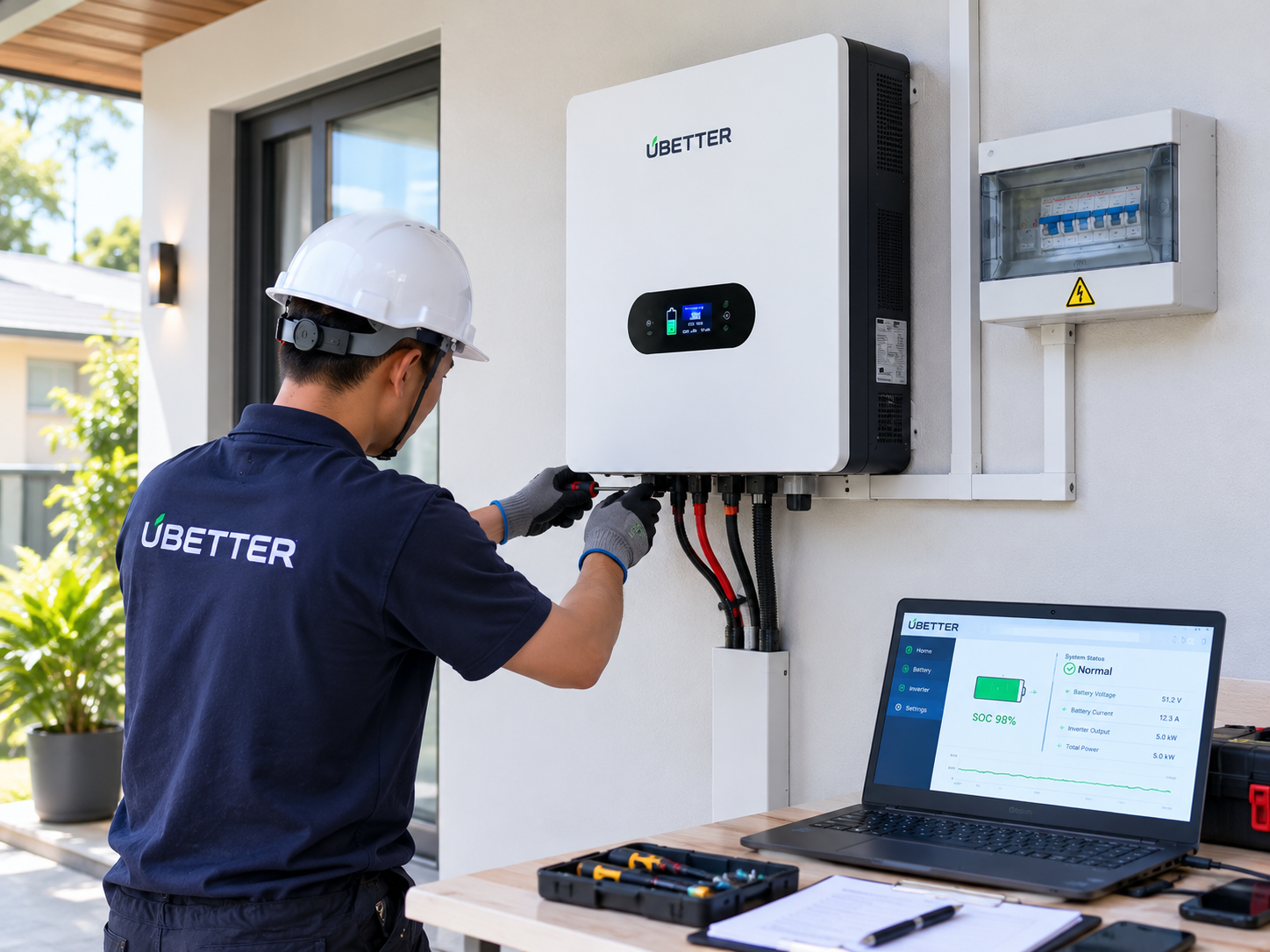
Correct installation and commissioning are essential for a reliable residential energy storage system. A battery should not be considered ready for use simply because it has been mounted and connected.
A qualified installer should follow the product documentation and applicable local electrical regulations.
The main commissioning checks generally include the following.
Mechanical installation: Confirm that the mounting structure, brackets, fasteners, and clearances meet the manufacturer’s specifications.
Electrical connections: Verify cable sizing, polarity, terminal tightness, grounding or bonding where required, and the suitability of protective devices.
Battery and inverter communication: Confirm that the inverter recognizes the battery and that communication settings, battery parameters, and supported firmware are correct.
System configuration: Set appropriate charging limits, discharging limits, state-of-charge reserves, and operating modes according to the product documentation and customer requirements.
Functional testing: Verify normal charging and discharging operation, monitoring data, alarms, and backup functionality where supported and appropriate to test.
Customer handover: Explain basic operation, monitoring, maintenance requirements, emergency isolation procedures, and the relevant warranty documentation.
Electrical installation and commissioning should be carried out by appropriately qualified personnel. Energized equipment and battery terminals must not be handled by unqualified users.
Who Can Benefit from Wall-Mounted Home Energy Storage?
Wall-mounted residential batteries are suitable for a range of applications when the selected product and installation meet the project’s requirements.
Homes with Rooftop Solar
Homeowners can store surplus solar electricity for use in the evening or during periods of reduced sunlight. The potential benefit depends on solar production and household consumption patterns.
Homes Experiencing Unreliable Grid Supply
In areas where electricity interruptions occur, a battery system with compatible backup equipment can help maintain power to selected essential appliances.
Homes with Limited Installation Space
Properties with restricted floor space may benefit from a wall-mounted design, provided a suitable mounting location is available and all required clearances can be maintained.
Solar Installers and Residential Energy Distributors
Installers and distributors can evaluate wall-mounted LiFePO4 batteries as part of residential solar packages, backup-power projects, and customized home energy solutions.
For these businesses, consistent product documentation, inverter compatibility information, installation guidance, and dependable technical support are important considerations when selecting a manufacturing partner.
Why Consider UBETTER for Residential Energy Storage?
UBETTER Technology Company Limited focuses on lithium battery and energy storage solutions for residential and commercial applications.
For customers evaluating wall-mounted home energy storage, the most important considerations are finding a battery configuration that matches the project’s electrical requirements, confirming compatibility with the selected inverter, and obtaining clear technical information before installation.
UBETTER offers LiFePO4 energy storage solutions for different application requirements, with OEM/ODM services available for customers seeking customized product options, subject to project specifications and manufacturing feasibility.
When evaluating a UBETTER residential battery, customers can discuss the required capacity, system voltage, installation arrangement, inverter model, communication requirements, and intended backup loads with the company to identify a suitable configuration.
For installers, distributors, and solar businesses, providing these details at the quotation stage can help reduce compatibility issues and improve project planning.
Frequently Asked Questions
1. What is the main advantage of a wall-mounted home battery?
Its main advantage is space-efficient installation. By mounting the battery on a suitable wall, homeowners can preserve floor space while storing electricity for later use. The actual benefits depend on the battery’s specifications and the complete system configuration.
2. Is a LiFePO4 battery suitable for home energy storage?
LiFePO4 batteries are widely used in residential energy storage because of their thermal stability and cycle-life potential. Suitability still depends on product quality, BMS protection, operating conditions, installation quality, and compliance with applicable standards.
3. How much battery capacity does a home need?
The required capacity depends on daily electricity consumption, the amount of solar electricity available, desired backup duration, and the appliances that need to operate during an outage. Reviewing actual consumption data is a practical starting point.
4. Can a wall-mounted battery work without solar panels?
Some compatible battery systems can charge from the grid and supply stored electricity later. Whether this is practical or permitted depends on the inverter, system configuration, electricity tariff, and local regulations.
5. Can a wall-mounted home battery provide backup during a power outage?
Yes, if the complete system supports backup operation and has the necessary inverter, isolation, transfer equipment, and electrical configuration. A standard grid-connected system without backup functionality may shut down when the grid fails.
6. Can wall-mounted batteries be connected in parallel?
Some models support parallel connections to increase total storage capacity. The permitted number of units, communication setup, cable arrangement, and inverter compatibility must be confirmed in the manufacturer’s documentation.
7. How long does a home energy storage battery last?
Service life varies with battery chemistry, cell quality, operating temperature, charge and discharge patterns, depth of discharge, and maintenance conditions. Buyers should review the manufacturer’s cycle-life test conditions and warranty rather than relying on a single headline figure.
8. What information is needed to select a compatible battery?
Useful information includes the existing inverter model, battery voltage requirements, daily electricity consumption, desired backup loads, available installation space, and whether future capacity expansion is required.
Conclusion
A wall-mounted home energy storage battery can help homeowners make better use of solar electricity, preserve floor space, and support backup-power applications when integrated with compatible equipment.
The most effective solution is not necessarily the battery with the largest capacity or the lowest purchase price. It is the system that matches household consumption, power requirements, installation conditions, inverter compatibility, and long-term operating expectations.
For homeowners, solar installers, and energy storage distributors evaluating residential solutions, UBETTER provides LiFePO4 battery options and OEM/ODM services to support different project requirements.
Looking for a wall-mounted home energy storage solution? Contact UBETTER with your required battery capacity, inverter model, and application details to discuss a suitable configuration.
About UBETTER: UBETTER Technology Company Limited develops and supplies lithium battery and energy storage solutions for residential and commercial applications.
Website: https://www.ubetterenergy.com/